Thursday, August 25, 2011

7 Things I Learned from the First Blogger - James Altucher


I was first called “Charlie Brown” in 8th grade. I refused to stand up and say the Pledge of Allegiance with the other kids. I didn’t like being forced to do anything. Afterwards some kids came up to me.
“Hey Charlie Brown,” one of them said, “you a commie?”
“No,” I said, “I just don’t like being forced to do something.”
“He’s more like a Linus,” Larry Sorbino said. Having stayed back a grade or so he was having more sex than anyone else in junior high school. I was definitely jealous of him. Everyone laughed because he was the leader of the roost. “Linus, hahaha.” And then for the next few months people would pass me in the hallway and sneer, “Hey Linus, haha” or, when they forgot who Linus was, “Hey Charlie Brown, haha!”
(the first Charlie Brown strip)
Since I was about 4 years old I had been buying the Charlie Brown collected strips. Usually after a doctor’s visit my mom would get me a book of the strips. I was thinking this the other day because I took my kids to Friendly’s. The waitress came over and said, “what would you guys like?”
“Well,” I said, “first off, about 38 years ago I left a Charlie Brown book in a Friendly’s by accident and when my mom and I came back to look for it it was already gone and I’m wondering if since then anyone has reported it lost or if it’s maybe in the lost and foud.”
“Uhh,” the waitress said, “I’ll check.”
“Daddy!” both my daughters said and they were embarrassed. Why’d they have to have a daddy like me? Even Claudia said, “oh no.”
“But,” I said, “I’m serious. I really wanted to read that book and my mom had just gotten it for me. We were coming from the doctor’s office. I had a vaccine shot then. I needed Charlie Brown.”
Charles Schulz, the creator of Charlie Brown, wrote the strip from 1950 to 2000, just about every day. He was basically a blogger. I don’t even know if he missed a single day.
It’s hard to come up with ideas that are meaningful every day. But he did. Here’s 7 things I learned by reading his various biographies and also by probably reading every strip he every produced.
1)      He made over a billion dollars in his lifetime.  Nowadays when we think of a billion dollars we think of a guy like Mark Zuckerberg or the Groupon guys, who seem to have made a billion dollars overnight. We get jealous (I do) and think, “I could’ve done that. These guys got lucky.” But Charles Schulz showed that through recessions, stagflation, wars, high taxes, low taxes, whatever -  persistence and making sure you’re creative every single day so each day you outshine yourself and your peers a little bit more, will get you a billion dollars. Creativity every day is the key part.
(the blanket is almost like an archetype. Everyone has a version of Linus's security blanket)
2)      He had a creative process. I may have mentioned my own process before.
-          My process:  I wake up around 5am, give or take. I drink 3 cups of coffee and by the third cup I’m at the computer writing.  I read for about an hour – only strong autobiographical voices (fiction or non-fiction) [See, My Summer Reading List], then I write a blog post. I write at least a post a day even if I don’t post every day. It takes me anywhere from a half hour to eight hours to write a post. A typical post is 800 – 2000 words.
-          Charles Schulz’s process: He woke up and ate a jelly donut. Then he’d try to come up with an idea, a process he said took him between a few minutes to 3 hours. Then he would draw and ink up the strip, which would take up to another three hours. He “posted” every day, 7 days a week.
I think creativity doesn’t happen spontaneously. I think the key is persistent exercise of the creative muscle. Doing the same process every day so your brain and body expect it and know what to do once you are “in process”. That makes the possibility of having spontaneous GREAT ideas come out during those hours much more natural and easy. [See, Nine ways to light your creativity ON FIRE]
3)      Success happens over decades. I said this in #1. But it’s a specific point also. Charles Bukowski wrote for three decades before he was able to make a living at it. Charles Schulz built Charlie Brown into a powerhouse over the course of five decades. For the first two decades of Warren Buffett’s investing career, nobody knew who he was. Now he’s the richest man in the world. [See, 8 Unusual Things I Learned From Warren Buffett]
This is a hard thing for me to learn. I’ve been on and off writing for two decades, writing professionally for one, but only blogging for less than one year. And sometimes I’m really impatient for traffic, etc. But I don’t even quite know what it is I want yet. I’m very confused on this point. The only thing I know I want to do is write / post every day and build community around the posts. Schulz ultimately drew 17,897 strips. One critic said that its arguably “the longest story ever told by one person”.
4)      He loved what he did. I don’t think real success could come any other way. It seems like the formula is passion + creativity + persistence + process. When sickness was forcing him to retire (about a year before his death) he said to Al Roker on the Today Show: “”I never dreamed that this would happen to me. I always had the feeling that I would stay with the strip until I was in my early eighties, or something like that. But all of sudden it’s gone. I did not take it away. This has been taken away from me.””
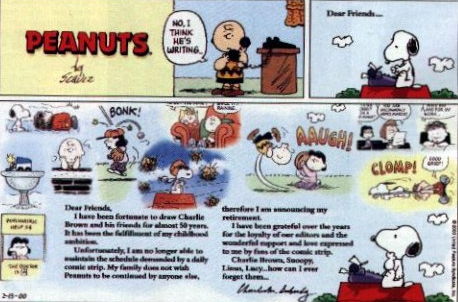
Here’s the last Charlie Brown strip that appeared. It came out on February 13, 2000 (the day after Schulz’s death)
5)      He had a stance and wasn’t afraid to state it. I’ve seen over and over in my blog posts that people are afraid to even remotely THINK anything that’s outside the box that society has built for us and put us in. Schultz was always trying to step out of that box and because he did it under the guise of sweet looking children, hardly anyone noticed.
For instance, 50 years before our constant worries about Google and Facebook privacy Schultz introduced a minor character named “5” (who had sisters “3” and “4”) whose last name was his zipcode. Apparently “5”’s father was protesting that everyone now is being boiled down to just a number, taking away our individuality and privacy. Here’s the first strip with 5:
6)      Losers win.
Charlie Brown is not a bad guy. He’s a very sweet little boy. He tries to do good things. He wants to kick the ball, to get advice on how he can be better, to have more friends, to even have a girl (“Heather, the little red-headed girl”) love him. But he rarely gets what he wants. And yet, with 350 million readers worldwide at his peak, he’s one of the most beloved characters of all time. Nobody wants to read about the kid who wins every game. We all relate deep down in our hearts to the person who is isolated, a little lonely, who wants something better out of life than the cards that have been dealt him. Not that everyone is depressed. Charlie Brown is not depressed. He just loses. And so do I. And so do you. We’re all in it together to try to be a little happier in a world that’s just a little too tough on us.
Focusing on these darker elements in life, and examining them in almost 18,000 strips, is how Schulz defined his characters and shaped his stories. Don’t brag to us. Tell us how you tried to kick the ball and failed. Ultimately, Charlie Brown’s innate kindness is what caused the other kids to rally around his choice of a sickly tree in the Charlie Brown Christmas Special. Being kind against all struggles creates art, friends, beauty, happiness.
7)      He worked 100% of the time. Even when he wasn’t actively engaged in his process of drawing, he was constantly thinking of ideas and thinking of new ways to draw. This, despite the fact that on the surface the strip seems relatively simple to draw. In Schulz’s own words:
“While I am carrying on a conversation with someone, I find that I am drawing with my eyes. I find myself observing how his shirt collar comes around from behind his neck and perhaps casts a slight shadow on one side. I observe how the wrinkles in his sleeve form and how his arm may be resting on the edge of the chair. I observe how the features on his face move back and forth in perspective as he rotates his head. It actually is a form of sketching and I believe that it is the next best thing to drawing itself. I sometimes feel it is obsessive, but at least it accomplishes something for me.”
I look at his lifetime and I’m jealous even though he’s dead and I’m alive. He did the only thing he ever wanted to do, he had an audience for it, he made a lot of money doing it, he never got burnt out, he said what he wanted to say, and he said it every single day. I hope I’m so lucky
When I was a kid I would be really upset at the other kids who called me “Charlie Brown”.  But now I’m thinking it wasn’t so bad after all.

Saturday, August 13, 2011

You are not running out of time - Rahul Bijlani


You are not running out of time

or How I Learned to Stop Worrying and Began Enjoying Infinity

Rahul Bijlani, October 2010

Tale of two conquerors
Early in his political career, Julius Caesar is said to have wept upon reading a biography of Alexander the Great. When asked why, he apparently said, “Do you think, I have not just cause to weep, when I consider that Alexander at my age had conquered so many nations, and I have all this time done nothing that is memorable!”
This story was seared in my memory when I read it in high school, because it spoke to my own search for achievement: I had read that at 17, Bill Gates had already created his first successful business venture. At the same age, I hadn’t even figured out where to start. It didn’t make me weep, but it did make me worry.
And so, incredibly, at 17 I genuinely wondered:
was I running out of time?
It seems amusing now – but back then I was deadly serious.

The game

You know the feeling – the feeling of being left behind in the race for achievement. Of falling back in ‘the game’. For some people, the game is keeping up with the Joneses: marrying a good catch, living in a nice house, driving the right car, having a good job, kids that do well at school. For others, it is enjoying life’s pleasures – the best vacations, the most enjoyable parties, with the most exciting partiers. Then there are people who are forever pursuing harmony and peace in their lives, resolving the discordant threads one by one, and for some the game is living up to their personally defined objective definition of personal development.
For most, it is a combination with a common thread: Am I moving up in the world at an acceptable pace, or am I running out of time? Am I maximizing my potential?
What that quickly meant to me was that wasting time and opportunities were criminal, with my own potential achievements as victims that needed to be rescued from the assault of lost hours and non-productivity. It meant becoming a workaholic. Bill Gates probably felt that way once – looking back at his teenage years and his own obsessive time spent with computers, he said,
“it was hard to tear myself away from a machine at which I could so unambiguously demonstrate success.”
I thought I was on the right track.

A moving target

Ironically, when I started to cross some of my own personal benchmarks, I discovered that something was very wrong – I kept moving the goalposts.
One counter-intuitive handicap of playing the game is that with every step you move forward, two things happen:
  1. You discover that its possible to go further than you previously knew, and
  2. The people you are left playing with are better at the game than people left behind. In other words, distinguishing yourself from your peers gets tougher as your definition of your peer group gets upgraded. It must have been easy for Bill Gates to stand out at Harvard, not so much in Silicon Valley, where he has constantly competed with Steve Jobs, Larry Ellison and others master games-men.
Thats why the ‘acceptable pace’ aspect of moving up in the world keeps evolving as you discover greater and greater opportunities. When Bill Gates made his first million, it probably felt extraordinary to him and a landmark achievement. How about his 2nd? His 20th? His 100th? How did he know he wasn’t running out of time to achieve his true potential when he made his first billion? If he was measuring himself on market domination, where would he go after 95% market share was secured?
The questions I had got crazier, but they seemed logical progressions of understanding the game. For example, geneticists say that one in 12 Asian men is descended from Genghis Khan. How did Julius Caesar feel about not leaving behind his empire to his progeny? Or Alexander for not having any children at all? Does that mean Genghis Khan played the game better? What does that make Bill Gates feel about marriage and kids? Does it make sense for him to have a harem, for example? Would it make sense for me to have one? And one child showered with attention, or the risk spread over a couple hundred?
If you keep asking these questions, how can you not keep moving the goalposts? How can you not get exhausted, overwhelmed, anxious?

The journey

Eventually, I came across a thought from ‘Zen and the Art of Motorcycle Maintenance’. In the story, Pirsig, a young man, goes mountain-climbing with some elderly monks. He struggles throughout, and eventually gives up, while the monks easily continue to the peak. What is apparent is that Pirsig, focussed as he is on the peak, is overwhelmed by the climb, and continues to lose his desire and strength with every step. The monks, on the other hand, used the peak only as a guide to mark the direction of their climb; they were more focused on the journey and its enjoyment, and made it to the top with ease.
This offered a valuable insight. Maybe Bill Gates doesn’t sit and ponder these definitions of success: maybe he keeps it simple – to maximize his fortune and have a small loving family – and simply enjoys programming. Maybe Alexander simply enjoyed battles, and Stephen Hawking loves physics. It would appear that they would still be active in those pursuits regardless of the relation of their endeavors to material success.
This would also suggest that the game – i.e. maximizing your potential, and what you can achieve with your time and resources – is best played if you enjoy the pursuit of your goals. In other words – if you are journey based, rather than destination driven. Pirsig’s monks probably just liked walking in the mountains, maybe they were as not wedded to the idea of standing on a peak as they were to enjoying nature.
Earlier, to me the game meant maximizing your time and potential to get somewhere, now it meant maximizing those things to enjoy the trip. That would mean that Bill Gates measure of success is how much he enjoyed his day, not how much code he wrote, or how much his businesses expanded.
A revolutionary thought! The point of my life was to enjoy it to its potential, with goals to set the direction in which I was headed.
This was my new definition of the game.
And it meant it was impossible to run out of time, because every day was a brand new opportunity to play and win.
But that still begged the question: how do you pick your destination? Doesn’t it keep moving, every time you re-evaluate the meaning of success? The monks had a fixed peak in the mountains they were climbing, most of us don’t have the luxury.

The right question

The answer to these questions occurred to me somewhat unexpectedly, through the best line in an otherwise unremarkable movie.
In Wall Street 2, right after he has cheated his own daughter out of her trust fund, Gordon Gekko, Hollywood’s favorite bad guy, is confronted by his future son-in-law, who chastises him for his seemingly slavish devotion to money. Gordon hears him out, and responds,
“You never did get it, did you? Its never been about the money – its about the game!”.
While the audience shook its head in disapproval, a lifetimes worth of questions were answered for me in a flash, and I wanted to jump up and cheer: I had the answer – Gordon was playing the game exactly right, and thats why he was exactly wrong!
He wasn’t running out of time, and he genuinely enjoyed every day of playing the game. He didn’t even care about the money, which he made and lost and made back. And yet, he was unhappy and it was clear that something was very, very wrong.
What I realized was that playing the game the right way isn’t good enough – it needs to be played for the right reason: it has to be played to build something, to see something grow. Gordon wasn’t building anything at all, not even a family, and his emptiness showed dramatically.

The destination

The answer to how you pick the destination: by asking yourself, what do I want to see grow? What do I want to build?
Even Bill Gates seems to have an opinion on this. “I’m a great believer that any tool that enhances communication has profound effects in terms of how people can learn from each other, and how they can achieve the kind of freedoms that they’re interested in.” And sure enough, he’s been building these tools all his life. All the money he made doing it? He’s giving it away. And he’s enjoying that process too!
Einstein wanted to build a theory that unified the physics of very large objects, like planets and the physics of very small objects, like atoms. Did he complete his project, before he died? No – but he left a legacy and a foundation for generations of future scientists to keep building on. I doubt he felt like he had run out of time.
A couple years ago, Steve Jobs built a phone that he wanted to see exist, and changed the world forever. Did he really need the money? Or the influence? Or the acclaim? Or was he simply trying to create something, and enjoying the process of seeing his vision come to life?
All of these examples suffered numerous setbacks as well as many opportunities to retire early in life, but chose to keep moving, because of what they wanted to build. The examples that they offer suggest that if you know what you want to build, and play the game to enjoy the journey, you are probably on your way to the good life. All of a sudden, the ‘Am I running out of time?’ question becomes meaningless.
Imagine building a house – would you really want to rush it? Lets imagine you faced an interruption – perhaps a snowstorm halted construction for a week. Would it make sense, or even be safe or wise to continue at the same pace during the storm? You wouldn’t feel bad about the delay, you’d just wait till you could resume. Or lets imagine you ran out of funds. Would you abandon the project because it was running behind time? Or find a way to continue in the future? If the foundations were poured and then you were diverted for a year, would you consider the construction to have moved backwards, or merely paused?
Now imagine building a family, or a skillset, or any object or business. Is it more important to do it rapidly and compare it to others or to build something that will last, and bring your vision to life?

A recipe for life

These questions are also why comparisons don’t really make any sense. Julius Caesar was weeping for all the wrong reasons. Alexander and he had different visions, they were looking to build different things in different times. Similarly, it was meaningless for my 17 year old self to measure myself against a very different person’s desires at a completely different time and place. In doing so, I was denying my own dreams, and trying to live someone else’s – and that too, dreams I imagined that person to have, without knowing what their dreams really were. Maybe all Bill Gates was trying to do at 17 was impress his high school crush. Maybe Alexander was trying to live up to the dreams of his father. The reality is that nobody will ever know!
Work, spouse, kids and family are not items to be checked off a list – they are directly based on the vision of the life you are trying to build, and settling based on a clock is merely a guarantee that the vision is being compromised. On the other hand, realizing what you want to build, as opposed to solely playing the game, may dramatically impact the choices you make.
In fact, answering the ‘what do I want to see grow’ question impacts all decisions, from what to do on a Saturday afternoon, to whether you should move to a different city for your work. It makes near term and long term destinations clear, and then all that is left is to play the game, or maximize your potential, to enjoy the journey of getting there. It also explains why the Gordon Gekkos and Julius Caesars of the world, who play the game just for its own sake, are generally unhappy and unsuccessful in their own eyes, even though they appear to be doing everything right.
A wise man once said happiness is the ultimate currency. The phrase resonated with me, but ‘the game’ didn’t help me maximize the currency that mattered most. Now however, at 30, I think I have the ultimate business plan, and nobody is running out of time any time soon.

Monday, August 8, 2011

That Tweet Just Doomed Your Wall Street Career: William D. Cohan


As if it weren’t difficult enough to find a job in this still-struggling economy, prospective employees have a new hurdle to overcome: the dreaded -- and highly sophisticated -- social-media background check.
Thanks to an increasingly popular service provided by Social Intelligence Corp., a year-old company in Santa Barbara, California, an applicant’s every faux pas, every bit of perverse logic, every bit of a tongue-in-cheek comment that falls flat -- to say nothing of overt or implied prejudice and lewd personal photographs -- can now be easily scraped off Internet networking sites including Facebook, Tumblr, Twitter and LinkedIn, and compiled in an attractive dossier that can easily be used to zotz you from any potential job.
We have heard warnings for years, of course, about how seemingly innocuous, or highly personal, utterances shared with friends on social networking websites can live on forever and potentially doom a budding professional career. And we were all recently treated to the jarring spectacle of Congressman Anthony Weiner’s well-deserved self-immolation -- in 140 characters or less.

No Buried Secrets

But these days, thanks to Social Intelligence, whatever challenges employers once faced by having to search site after site to find information about prospective employees has been solved by -- and outsourced to -- the company’s algorithms, an inevitable consequence of the power ofsearch engines in the Internet Age.
“We are not detectives,” Max Drucker, the chief executive officer of Social Intelligence, told the New York Times in a much discussed article. “All we assemble is what is publicly available on the Internet today.” A sobering observation for sure.
If the message were not already crystalline, there is no longer any doubt that extreme vigilance with regard to social networking is no longer an option -- it is a necessity. Who knows how many budding presidents of the U.S. or CEOs of Goldman Sachs have already been nipped in the bud by Drucker’s handiwork? He told the Times that he found one prospective employee searching for OxyContin on Craigslist, and other background checks found damning evidence of racist and anti- Semitic remarks.

Good Old Days

Once upon a time, before the Internet, such sleuthing would have been nearly impossible, meaning that many people happily and productively employed in the highest ranks of corporate America no doubt have committed inchoate acts of foolishness that today would be punished early and often.
Can this be considered progress or evidence that Big Brother is very much a part of daily life? To help people begin to grapple with the implications of this kind of digital monitoring, a review of a few of the more insightful online comments about the Times story is instructive.

Basic Internet Hygiene

A “John Doe,” in New York City, wrote that he thought schools should teach “basic internet hygiene,” including to “assume that everything you post under your true name will forever be in the public domain, because, well, it will be” and to “never post a photo of yourself online unless it is bland and you can absolutely control access to it.”
“Doe” has little use for social networking. “In general, the less of yourself that appears online, the better off you will be,” he wrote. “Facebook? No thanks.” He also wrote that he expected legislators to do little to protect us from the more heinous aspects -- mistaken identity, for instance -- of Social Intelligence’s dossiers. “If they get it wrong,” he wrote of Social Intelligence, it could destroy “a person’s life with no possibility of appeal. Naturally, our leaders in Congress can be expected to do nothing about this. After all, we are not wealthy bankers.”

Very Slippery Slope

Other commenters simply see this new service as the beginning of a very slippery slope. “This is us, giving up a little essential liberty -- one photo, one text, one post, one status update, one Tweet at a time,” “K. Johnson” wrote. Added “DCS”: “I’ve never said or done anything online that anyone could possibly take offense to. I just hope I don’t have to interview with the one person who takes offense at people who have never said or done anything offensive online.”
“John,” in Northern California, worries that the new dossiers will be used, and candidates rejected, but no fingerprints will ever be left behind. “They won’t tell you that’s why they aren’t hiring you,” he wrote. “You’ll just be skipped over, the same way people or groups routinely are now if they don’t fit a certain ethnic, racial or physical (fat, thin) profile. They won’t admit this, however, and you can’t prove it.”

A Private Diary

Then there is the slightly perverse but well-taken logic that “Gramercy” displayed in a comment. “I actually applaud this,” it read. “It may be because I consider myself as an adult who uses social media just to keep in touch or because I am getting older, but I am actually glad to see that indiscretions and bad judgment exhibited online can and will be held against those pinheads who use the Internet as their private diary. And while I am at it, we should set standards: anyone who has seen a full episode of Jersey Shore or the Housewives of whatever, or can identify the names of the Kardashians should not be allowed to hold a real job or to drive for that matter.”
Given the existence of companies like Social Intelligence, it just makes common sense not to put anything in an e-mail or social networking post that you wouldn’t be proud to see on the front page of the New York Times.
(William D. Cohan, a former investment banker and the author of “Money and Power: How Goldman Sachs Came to Rule the World,” is a Bloomberg View columnist. The opinions expressed are his own.)

Thursday, July 21, 2011

How To Live Forever - credits James Altucher


How To Live Forever

Lets say you knew that on December 15, 2020, you were going to die in Springfield, Illinois. What would you do? Well, for starters you would probably prolong your life simply by avoiding Springfield, Illinois on December 15, 2020. It just so happens we can use statistics to see the future, and by doing so, can postpone death as long as possible.
I’m sick of the anti-aging industry. Basically, nothing fancy works. Dr. Oz recommends reservatrol but scientific studies only show that enormous amounts of it are what expands the lifespan of a mouse. There’s no way to take an equivalent amount as a human. Anti-aging expert Andrew Weil often suggests herbal remedies instead of pharmaceutical medicines but I think, again, the research is very unclear and it’s no secret that lifespans have gone up in general with the rise of more readily available, FDA-approved pharmaceuticals. There’s always a lot of discussion of homeopathic medicine but, again, the evidence is lacking.
My view is to take a very common sense view towards aging. By the way, I have never thought about anti-aging techniques before. But I’m 42-years-old now, and probably past the half-point of my life, so I’ve started to wonder about it. Common sense has served me well in most other areas of my life. Hippocrates, the father of modern medicine, puts it succinctly with “Do no harm” in his hippocratic oath. There’s a similar rule in the area of financial advice which I think applies here as well. It’s actually two rules, stated by Warren Buffett, the greatest investor ever: “Rule No. 1: Don’t Lose Money. Rule No. 2: Don’t Forget Rule #1.”
The Warren Buffett approach is appealing. Think about it from a financial perspective. Most of the reasons people go broke is not because they failed to make money but because they spent their hard-earned money on bad investments that went to zero. In other words, they broke Buffett’s rules. Much more important than figuring out how to add dollars to your net worth is how to avoid losing the dollars you’ve already accumulated. Applied to the anti-aging industry — don’t spend so much time figuring out how to add years to your lifespan. How about use common sense to make sure you don’t make additional decisions that cost you your health.
We know what the main killers are in life (this comes from the Centers for Disease Control, U.S. Government, data):
Top 10 Killers
Heart disease: 616,067
Cancer: 562,875
Stroke (cerebrovascular diseases): 135,952
Chronic lower respiratory diseases: 127,924
Accidents (unintentional injuries): 123,706
Alzheimer’s disease: 74,632
Diabetes: 71,382
Influenza and Pneumonia: 52,717
Nephritis, nephrotic syndrome, and nephrosis: 46,448
Septicemia: 34,828
So lets start by avoiding some of these diseases.
1. No Smoking. You only have to go to the American Heart Organization website to see their research on how smoking is related to heart disease.  A quote: “Smoking increases blood pressure, decreases exercise tolerance and increases the tendency for blood to clot. Smoking also increases the risk of recurrent coronary heart disease after bypass surgery.” That doesn’t sound good. There’s also numerous studies on the effects of smoking on cancer. Go to cancer.gov. Here’s a  quote: “Of the 250 known harmful chemicals in tobacco smoke, more than 50 have been found to cause cancer. These chemicals include:
arsenic (a heavy metal toxin)
benzene (a chemical found in gasoline)
beryllium (a toxic metal)
cadmium (a metal used in batteries)
chromium (a metallic element)
ethylene oxide (a chemical used to sterilize medical devices)
nickel (a metallic element)
polonium-210 (a chemical element that gives off radiation)
vinyl chloride (a toxic substance used in plastics manufacture)”
That’s pretty bad. I just have to read the first: “arsenic.” Who wants to put arsenic in their body? Don’t forget rule #1!
(smoker's lung on the left side of the image)
2. No Heavy Drinking. Note that I say “heavy” drinking and not drinking in general. In fact, many studies show that moderate drinking reduces the risk of heart attacks by up to 40 percent. Go to this link: http://www2.potsdam.edu/hansondj/HealthIssues/1109728149.html .It has a list of studies that show the types of cancers that moderate drinking actually help prevent. What is moderate versus heavy drinking? At cdc.goc, “drinking in moderation is defined as having no more than one drink per day for women and no more than two drinks per day for men.”
Heavy drinking, on the other hand, is lethal. Obviously, it increases your risk of having a fatal accident, but there’s numerous studies showing that heavy drinking is linked to various cancers, heart disease, and Alzheimer’s. Here’s a quote from Alzinfo.org: “In the study, researchers found that the combination of heavy drinking and heavy smoking sped up the age of onset of Alzheimer’s by six to seven years. That is a considerable number, making them among the most important preventable risk factors for Alzheimer’s disease.” Oh yeah, there’s that smoking thing again.
On heartdisease.about.com: “After their heart attacks, patients who had done any binge drinking during the previous year had a death rate that was 73 percent higher than patients who did not do any binge drinking. Even occasional binge drinking (as they defined that term in this study) increased the risk of death.” Binge drinking they define as having three or more beers in a day.
From the American Cancer Society: “Death from liver cancer is higher among heavy alcohol users than among people who do not drink.”
So it’s pretty simple. You can avoid accidents, heart disease and a bunch of cancers if you never drink more than two beers a day.
3. Sex. It doesn’t have to be all puritan. Maybe you like to smoke and drink a lot and now you’re pretty upset. How about taking up a more fun activity during the day, like sex. Here’s an article by Jonah Lehrer: “Sex is stressful but good for you.” (http://www.wired.com/wiredscience/2010/08/sex-is-stressful-but-good-for-you/)  Basically it shows that sex activates various hormones that increases your immune system, decreases your stress levels, reduces the risk of Alzheimer’s and all sorts of other good things. And it’s pretty much common sense that this is a good thing. Heck, the Bible recommends we do a lot of it.
There’s an article from WebMd on the 10 health benefits of sex. (http://www.webmd.com/sex-relationships/features/10-surprising-health-benefits-of-sex?page=2) One quote: “The researchers also found that having sex twice or more a week reduced the risk of fatal heart attack by half for the men, compared with those who had sex less than once a month.”
4. No snacking. Obesity is linked to high blood pressure, heart disease, diabetes, certain types of cancer, etc. There’s no shame in being obese. Over one-third of adult Americans are obese according to the Centers for Disease Control. And being overweight and enjoying food are not crimes. But if you stick to the basics you’ll avoid (reduce) being obese. Ugh, I’m really hungry right this second as I’m writing this. Since last year whenever the  market’s gone down I’ve felt an irresistible urge to eat. I’ll eat an apricot Danish, or a corn muffin, or a hot dog, Pringles, Doritos, or anything with Cajun spices. If you have some corned beef hash when I’m in this state, please send it over. I’ll eat all of it. I’m like a shovel working on Obama’s trillion dollars worth of road repairs, I’ll shove it all in.
This is not a healthy lifestyle and now that I’m about to breach  the age of 42 I have to think about my metabolism and how its beginning to weaken.  This happened to me once before, towards the tail end of the bear market of 2002. My entire life I’ve weighed my college weight except for that one time in 2002 when  I gained about 20 lbs. I read through all the diet books and nutrition sites but none of them made sense to me. So I came up with my own diet and it worked. What follows is the “James Altucher White Book Diet” as seen on Oprah, The View, the Today Show, Obama’s Inaugural speech, and other top Nielsen rated TV shows [note from ed.  Unable to verify] . It took me about two months to lose the 20 pounds once I started using this plan
  1. No sodas. Ever. One can of coke contains 16 sugars. That’s just mindless calories.
  2. No snacks between meals. Have a breakfast, lunch, and dinner. And that’s it.
  3. No white at night. Meaning, no pasta, no ice cream, no cheese, no bread. Nothing white at night. Enjoy a steak and some asparagus.
  4. One item for breakfast. Knock yourself out if you want a croissant. Or a bagel with cream cheese. Or a fruit cup. Or one Belgian waffle. But stick to only one item.
Do whatever you want for lunch. Doesn’t matter as long as you stick to the other rules above. And if you are also avoiding the heavy drinking then your calories will stay down and your weight might go down.
5. Exercise. I know, everyone says this. I don’t want to be boring so we’ll keep this simple and stick to the minimal basics. First off, its obvious that exercise and being in shape has health benefits. From the Mayo Clinic, there’s an article on the benefits of exercise. (http://www.mayoclinic.com/health/exercise/HQ01676) A quote: “Regular physical activity can help you prevent — or manage — high blood pressure. Your cholesterol will benefit, too. Regular physical activity boosts high-density lipoprotein (HDL), or good cholesterol while decreasing triglycerides. This one-two punch keeps your blood flowing smoothly by lowering the buildup of plaques in your arteries.”
And there’s more. “Regular physical activity can help you prevent type 2 diabetes, osteoporosis and certain types of cancer.”
BAM! We avoid the two top killers and probably a bunch more.
If you are already an exercise fanatic, then this section isn’t for you. But if you are not really that into exercise or you get bored with it then we need to figure out how to trick your mind and body into getting motivated to exercise. Minimally, you want to do a half hour of exercise a day but that can be spread out. Some ideas:
  1. Can you wake up 10 minutes earlier and do 30 push ups and 30 sit ups? If all you did was 100 push ups a day, spread out throughout the day (do 30 more during a commercial break, for instance), you’re going to get in good shape and build muscle.
  2. Can you take the stairs instead of an escalator whenever you get the chance?
  3. Can you park a little further from work and walk a half mile instead of parking right at the door?
  4. Take a tango lesson once a week or ballroom dancing. Or play a couple of games of tennis or even ping pong. Anything that can get you to sweat a little bit.
  5. Find a basketball court and just try to shoot 10 baskets. Just the jumping and shooting is decent exercise for 10 minutes and might be fun.
  6. Get someone to show you two to four yoga poses. Do them every day.
The key is just to get the body moving in a way that’s new and a little more difficult than its usual movements (sitting down, sleeping and eating). And if you’re really motivated and just want to get through a half hour of solid exercise, just do 100 push ups, 100 sit ups, and 100 squats in a half hour period. Do it three times a week and you’re set for life.
7.Sleep a lot. Sleeping is great. For one thing, when you sleep, you probably won’t have a fatal accident. Nor will you be eating while you sleep. Or drinking heavily or smoking, or any of the other activities that can cause an inconveniently timed death. In fact, lack of sleep (meaning six hours or less on average) is linked to colon cancer, weight gain, strokes, heart disease, high blood pressure, high cholesterol, depression. Don’t we all like to sleep a little more? Certainly sleeping an extra hour a day has got to be a lot easier than exercising an hour a day.
So how much sleep do you need? Seven to eight hours a night. More than that is not even necessarily healthy. Statistics show that people who regularly sleep eight hours a night, no more and no less, live the longest.
I have insomnia. I’ve also been day trading for a living, on and off, for the past ten years. I’ve traded my own money and others. It’s an unpleasant way to live. The highs are very high and the lows are very low and painful. Whether you are at the highs or the lows you’re probably going to experience insomnia along with 32 million other people in this country that have insomnia.
When I have insomnia here is the form it takes: I have no problem falling asleep. But then at about 2 or 3am, I am awake and can’t get back to sleep. The worst is when I finally get back to sleep around 5:30 but by then I’m in trouble: I’ll wake up around 6:30 or 7 completely exhausted for the day.
This is no good for a day trader. You need to be focused, on your game, and not make mistakes which cost you your livelihood because you are simply too tired to be sharp. Imagine if you take out $5,000 and just drop it on the street and walk away. You would be stupid if you did that. It’s also stupid to let insomnia force you into mistakes that cost you many multiples more than $5,000.
Some of the suggestions below may seem harsh. And the correct solution for insomnia will be different for everyone. But if you do follow the suggestions below, I can safely say it’s unlikely you will have insomnia.
  1. - No computer for the last hour of the day. Not only that, turn off the computer. There should be no computer sound or monitor light. The sound and light keeps you sucked into the virtual reality of the day trading world, where you live and die on every tick in the markets. You need to disengage from that world and enter back into the real world in order to sleep.
  2. - No food after 7pm. I really meant to write 5pm but that might be unrealistic for most people. Sleep and digestion are closely linked. Studies show that many people with insomnia have either irritable bowel syndrome (IBS) or sensitive stomachs. Not eating past 5pm and drinking more liquids throughout the day can help you be cleaned out for your sleep. You want to eat easy-to-digest foods at night. No meat, not too much sugar. Vegetables and fruits.
  3. - No alcohol. The sugar will pop you awake in the middle of the night.
  4. - Exercise. This is directly related to what happens to your body when you day trade. Imagine if you were mugged. Adrenalin and stress hormones would get released in your body and you’d either fight or flight. Fighting or running would work off those stress hormones. When you day trade, it’s as if you are getting mugged all day long — but you are just sitting there. You aren’t working off the stress hormones. Those chemicals will keep you awake at night. Exercise (if done early in the day) will at first increase the stress hormones but then over the next few hours after exercise finishes, will work those hormones off.
  5. - Clean your bedroom, your closet, your office, your kitchen, etc. Your mind and your living space need to be friends with each other. Clean mind equals clean living space. Cluttered space means cluttered mind. Cluttered mind leads to anxiety, nervousness, stress, and then those stress hormones are waking you up again in the middle of the night. Power down the computer and clean your room before you go to sleep.
  6. - Put closure on the end of your work day. Make a list of the work related things you did that day. Write them down on a pad. Trades you made, articles you read that you remember, ideas you had, calls you made related to business. I write everything into an email I send to myself. It helps me to see how productive I was (or not), particularly on days that might not have been that good otherwise (i.e. if I lost money trading that day). It also helps me understand and analyze my trades a bit more. And finally, when I hit “send” on that email to myself, my day is over. Onwards to the next thing (talking to family, friends, etc).
  7. - Meditate. You don’t need to get in the lotus position and start chanting for an hour or two. Most of the time during the day, particularly when you’re stressed, you may stop and notice that your breaths are short and uneven. Sit in a chair for ten minutes, with the lights out or on dim. Simply watch your breath. Don’t breathe too deeply but as deeply as is natural. Count the breaths to ten. Then start over. If you find you are losing your place too much (or slipping into “11..12..”) then just count to five and start over. Do that for just ten minutes in the evening. Ideally, do it in the morning also before you begin your day.
  8. - Early to bed, early to rise. Ben Franklin is right. This will make you wealthy (maybe wise also but we’re focused on trading here). 5am is a good time to wake up, read the news, check futures, and plan your trades for the day. That gives you a little over 4 hours to get ready for the trading day. If you need 8 hours of sleep then backtrack from 5am to see when you need to get to sleep.
  9. If you follow these guidelines you will be on your A game when you trade, you will sleep better, and you will wake up each morning refreshed and ready to go.

7. Regular Flow. You know what I mean: constipation is bad. Imagine keeping all that horrible bacteria in your body one more second than you have to. Get it out! What happens is that fecal matter builds up in your colon, causing an unvirtuous cycle: the more fecal matter that builds up, blocking the openings of the colon, the more fecal matter gets stuck up there, putrefying for years, leading to everything from colon cancer to a breakdown of the immune system: more flus, allergies, heart disease, etc. The key of all of this article is how to very simply avoid the leading causes of death. Keeping the inside of your body clean is the simplest. Going to the bathroom more than three times a week is key. Everyone varies in this but ideally, at least once a day is enough to keep the factory working.
How to avoid constipation:
  1. Use it or lose it. When you have to go … GO!
  2. High fiber diet: fruits, vegetables, high fiber cereals (Dr. John Harvey Kellog, the founder of Kellog’s cereal, invented his high-bran, high fiber cereal for just this purpose).
  3. Lots of liquids
  4. Avoid eating too much low-fiber foods. Obviously we all like our ice cream. But too march starch and sugar could be bad, particularly if you are currently suffering.

8. Feel Gratitude. Stress effects every aspect of your physical health and can cause every single one of the causes of death mentioned above. Every technique described above indirectly reduces stress. But dealing with stress also involves building your mental muscles. Mental muscles are like physical ones — they atrophy. If you are bedridden for a few months then you would have to engage in intense physical rehab in order to even walk because your muscles would’ve atrophied that severely and quickly.
Its the same with mental muscles. The muscle that prevents stress needs to be regularly exercised or you will succumb to the excesses of too much stress in your life and you won’t be able to climb out of the hole. Believe me, I know this. At different times in my life I’ve made and lost millions. Part of what I do is I daytrade for a living. While there are many stressful jobs out there, daytrading has to be among the top 10. When I’m in a big position and it starts moving against me I feel every heartbeat in my body pushing the blood all around. The stress permeates me and part of the daily routine of a daytrader is learning to deal with the stress.
Think of the human body when its mugged, or when a car is bearing down on it. The human body signals a flight or fight response. Your adrenalin pumps through and its almost as if you have superhuman powers as you either run the fastest you’ve ever run, or you jump out of the way of a car or, god hoping, you block a car from running over your baby, as has happened in extreme examples. In other words, in a normal response to stress you feel the stress, your body produces the adrenalin and hormones to deal with it, and you react, quickly working off the stress.
But the normal daily grind that causes our stress almost never gets worked off. Its as if you are mugged all day long. And that leads to only bad things in the body (see all 10 killers above).
There are many ways to avoid stress but the one I’m focusing on in this technique is to exercise your gratitude muscle. Try it for just five minutes a day. List all of the things you are grateful for. Don’t think about anything else. You don’t need to meditate with the Dalai lama to reduce stress. All you have to do is for five minutes a day think about the things you are grateful for. Your kids. Your friends. The walk you took yesterday. The smile a stranger through your way this morning.
Once the muscle is exercised, then get it working again during the moments you feel stressed. If you are feeling stress about a family relationship, think about a time when that relationship was great in your life. If you are feeling stressed about money, remember that all things cycle and whatever you have this second is still enough for you to enjoy life. I know it sounds corny. But if you do that five minutes a day I can guarantee that you’ll be surprised at the new muscles you find.
9. Mental exercises. Nobody knows for sure how every detail of the brain works. But we do have a basic model. The brain has 100mm neurons, give or take, that communicate via synapses. When you learn something new, a bunch of neurons and their synapses fire up with traffic. The more traffic between neurons, the more their synapses strengthen. Like in the Gratitude section above, if we keep on strengthening the synapses between neurons all across the brain then we build up resistance to any illnesses that effect the brain, such as Alzheimer’s, the #6 killer above. Additionally, there are other benefits to keeping sharp: higher income, perhaps less stress, hopefully an ability to avoid accidents (like balancing your checkbook incorrectly), etc.
Some mental exercises you can do daily to keep sharp:
  1. Play memory games. Exercise your memory
  2. Get a book of brain teasers and puzzles and solve them.
  3. Play chess, checkers, poker, any game that requires some strategic thought and memorization.
  4. After meeting a person, try to remember everything he or she wore and said.
  5. Try to eat lefty every once in awhile (or right-handed if you are left-handed).
  6. Right now try to figure out what coins are in your pocket just by touch. Now do the same for bills (100 dollar bills are less worn than ones)
  7. Play boggle or any other game which takes a set of letters and you try to see how many new words you can form from it.
Like physical exercise, if you do mental exercises for 20-30 minutes a day for five days a week you’ll see dramatic results in a very short time.
10. Avoid hospitals.
Something like 40,000 people die each year from infections they get in the hospital according the CDC. Essentially, hospitals are filled with bacteria and hospital staff (not in every hospital, but some) routinely ignore the basic steps required to insure that people do not pass infections to others.
  1. Make sure anyone who touches you washes your hands first.
  2. Don’t read the magazines (or, if you are a kid, play with the toys) in the waiting lounges at hospitals or doctor’s rooms.
  3. Have an advocate with you preferably at all times.
A quick story: I was once pretending to be a respiratory therapist for a week in a hospital (long story) and I got to walk around with doctors, other respiratory therapists, etc on their routines. It wasn’t uncommon to hear a story such as “such and such nurse took the tracheotomy tube out but forgot to plug it up and the patient suffocated.” Again, not every hospital is like this but mistakes are made. There are millions of surgical procedures a year. Some complicated and some simple and all it takes is a tiny percentage of those to go wrong and the number of deaths from surgery accidents will far exceed the number of deaths from plane crashes each year. “The number of adverse events each year (is) equivalent to 13 jumbo jets crashing and killing all 350 passengers on board,” Kevin Rudd’s Australian National Health and Hospital Reform Commission says. An advocate every step of the way can insure that proper procedures are being followed.
  1. Question all surgeries. If the doctor says “can you do surgery next Tuesday,” find out first if there’s any other non-surgical procedures. I hate to be blasphemous to the medical industry but first check with an acupuncturist (a good one that is recommended by friends who were actually helped by that acupuncturist) or a chiropractor. See if physical rehab can help first, or at least be tried without detrimental effects to the body part in question.
  1. If you must do surgery make sure the surgeon has ample experience (no students!) and make sure a checklist is used durin the procedure (Atul Gawande has an excellent book on the topic of doctors using checklists.
  1. You want to get out of the hospital as quickly as possible if you are having surgery there. Here’s a basic tip: Don”t have your surgery on a Thursday. Doctors don’t want to work on a weekend. You might be stuck there for the whole weekend if you just need to be in the hospital for a max two days.
  1. If you are using a teaching hospital, try to avoid going there (if possible) during July. There is the notorious “July Effect” when interns become residents, residents become full-time doctors, etc. It’s the first time many of these new doctors are full time in their specialty and may not have the experience yet to accurately diagnose and prescribe the right medicines, etc. Here’s an article on the dangers of July in a hospital. (http://idiopathicmedicine.wordpress.com/2010/06/30/the-dangers-of-july-in-the-hospital/)
  1. Make sure the doctor has clear handwriting on prescriptions. Believe it or not, the famous ability of pharmacists to read the handwriting of doctors is just not true. Here’s a recent article (http://www.time.com/time/health/article/0,8599,1578074,00.html) claiming that 7,000 deaths per year are caused by poor handwriting on prescriptions.
  1. Avoid being plugged into an IV. If you can swallow liquids, drink the water, don’t have it put into you via a possibly contaminated IV unit.
11. Cleanliness. This one’s obvious. We collect bacteria throughout the day by touching doorknobs, staircase rails, elevator buttons, shaking hands, eating food, etc. Also, there’s the saying: “clean desk, clean mind.” In other words, keeping our environment clean is not only physically healthy but helps to reduce stress and makes you more productive. Reducing stress, as mentioned above, is key to avoiding many of the diseases that cause death.
  1. Wash hands every time you go from outside to inside. Under the nails is one of the dirtiest parts of the entire body and once you take those nails and rub your eyes or scratch an itch, you are infecting yourself with any bacteria that grabbed onto the inside of those nails. Keep them short. Wash them regularly.
  2. Brush your teeth. Bacteria is all over your mouth. Brushing after every meal is keep and before you go to sleep and after you wake up. It sounds annoying but brushing, flossing, and using a tongue scraper for anything that stays attached to your tongue will help prevent any disease and, of course, keep your breath clean.
  3. Make your bed. Who doesn’t like to come home to a made bed.
  4. Clean your desk.
  5. This is a drag but shower every morning and night. When you go to sleep at night you have a whole day’s worth of bacteria on your. Why take that bacteria and put it all over your nice clean sheets when you can avoid it?
12. Avoid accidents. This almost seems like an oxymoron. The word “accident” implies there is some degree of luck involved. Like you were walking along outside of a building and something falls out of a high up window and hits you. That’s an accident that seems like just bad luck. Or is it. We know that 123,000 accidents a year occur. So lets break that down a little further.
About half the accidental deaths come from car accidents. So one thing we can do is simply avoid getting in cars. Now, that’s not always possible because we need cars to get to work. But a couple of thoughts:
- If you have a choice: live closer to work. Or take public transportation.
- If you don’t have a choice: try to avoid doing more than one activity at a time while in the car. Don’t eat, talk on the cell phone, don’t play with the radio.
- Don’t jaywalk (don’t be the recipient of a car accident if its easy to avoid).
- Wear a seat belt
- About 1/3 of accidents happen at home. Don’t get fancy and try to fix the TV antenna on the roof. Don’t get on a ladder if you don’t have to. Be careful when walking down stairs, etc.
The anti-aging industry makes billions trying to get you to take fancy pills., buy expensive equipment, do expensive medical tests, etc. But sometimes the simplest way to live longer is to avoid all the ways you were going to die.